Spot Price and Market Basics
Understanding spot price is one of the most fundamental skills in the precious metals industry. Every transaction you will ever be part of, whether buying, selling, or refining, traces back to this single number. Yet most people entering the industry do not fully understand where it comes from, who controls it, or why it looks different depending on where you check it.
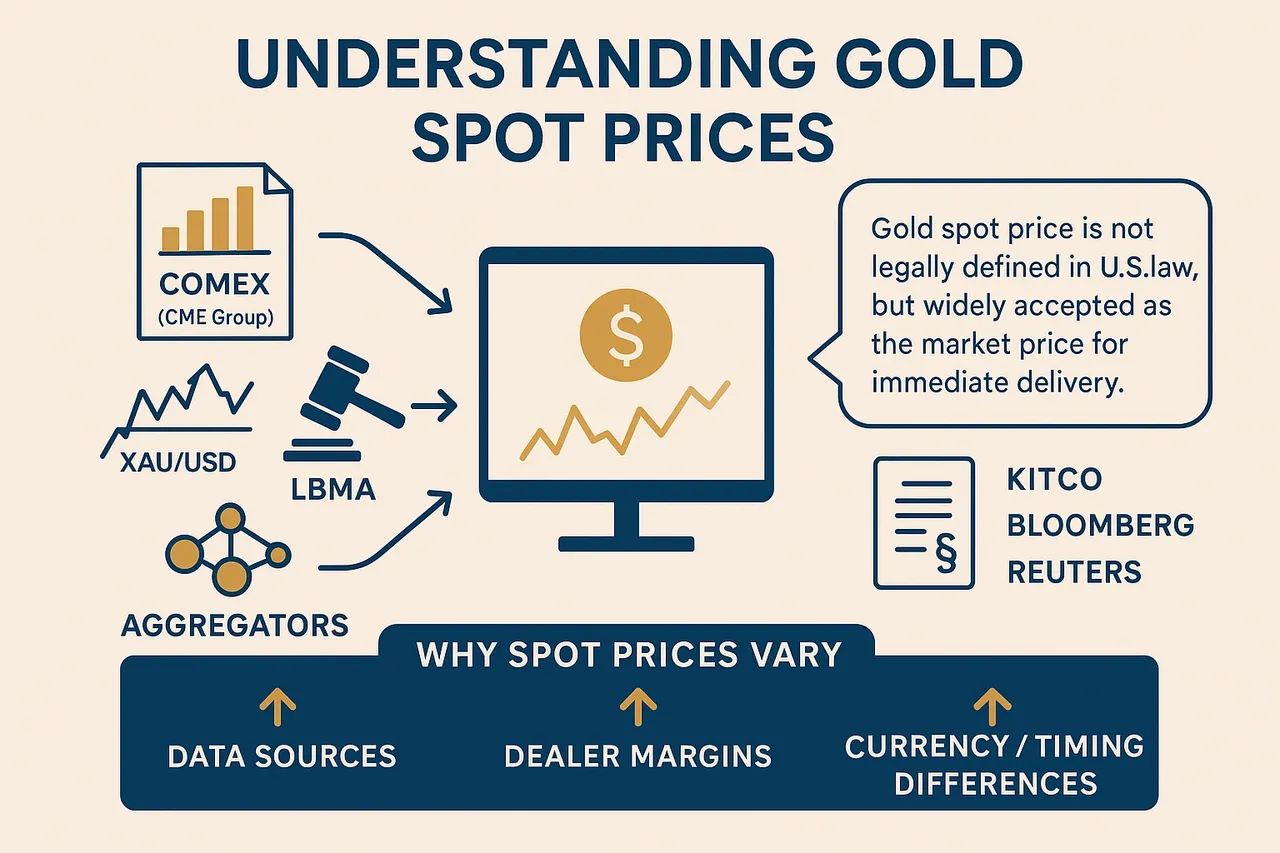
1. Where Gold Spot Prices Come From
Gold spot prices are derived from several interconnected sources operating simultaneously around the world:
- Futures Exchanges: COMEX (part of CME Group) is the primary source, driven by active trading of gold futures contracts.
- Global OTC Market: The LBMA (London Bullion Market Association) provides the global benchmark via its twice-daily auction.
- Forex and Spot Trading: Real-time gold trading via XAU/USD through global brokers contributes continuous price signals.
- Aggregators: Services like Bloomberg, Kitco, and Reuters publish live composite prices compiled from various sources.
The spot price is a real-time reflection of current supply and demand for immediate delivery of gold, shaped by all of these inputs at once.
One important distinction: when professionals quote spot price, they express it per troy ounce. However, the physical gold actually being traded in the professional spot market moves in much larger units. The LBMA standard is the 400 troy ounce good delivery bar, which is what central banks, refineries, and large institutions are actually buying and selling when spot price is being set. The per-ounce quote is simply the unit of measurement used to express that price universally.
Practical skill: You need to be able to convert spot price per troy ounce into other units on the fly. Customers will regularly ask what gold is worth per gram. Since one troy ounce equals 31.1035 grams, simply divide the spot price by 31.1035 to get the price per gram. Tools like Kitco allow you to toggle the display between troy ounces, grams, kilograms, and tolas, which is useful for serving international customers or working with different product formats.
What Spot Price Actually Reflects: Product Type and Location
The spot market reflects a very specific product in a very specific place. In this video I explain what qualifies as spot-tradeable gold, why location and custody matter, and why the gold bar in someone’s garage is not trading at spot.
2. Does U.S. Law Define the Gold Spot Price?
No. U.S. law does not provide a formal legal definition of the gold spot price. However, it is a well-understood and widely accepted term in the financial and regulatory world.
Regulators like the IRS and CFTC refer to spot prices implicitly, such as when valuing gold for tax purposes or IRA accounts, but they do not legally define the term.
It is generally accepted to mean the current market price per troy ounce for immediate delivery of gold, as quoted on exchanges like COMEX or LBMA, where large good delivery bars of approximately 400 troy ounces are the standard unit of physical trade in the underlying market.
When used in contracts or compliance documents, the spot price should always be clearly defined by the parties involved.
Common Customer Questions About Spot Price
Customers ask about spot price constantly, and most of their questions reflect common misconceptions. In this video I walk through the questions that come up most often and how to answer them accurately and confidently.
3. Why Spot Prices Differ Between Companies
It is legal and normal for gold dealers to display different spot prices. Here is why:
- Different Data Feeds: Dealers use different sources such as COMEX, LBMA, or forex markets, which update at different intervals.
- Dealer Margins: Some sites include small buffers or hedging margins built into their displayed spot price.
- Currency and Timing: Small differences in exchange rates or update frequencies can cause slight discrepancies between platforms.
This is legal because there is no government-mandated official spot price.
Why Spot Prices Differ Between Companies
In this video I go deeper into why different companies show different spot prices, including proprietary tickers, foreign currency conversions, and the difference between a live spot price and a futures price that customers sometimes confuse for spot.
4. Price in Relation to Spot: Why the Question Is Incomplete
A common call goes like this: a customer asks what price you pay in relation to spot. It sounds like a reasonable comparison shopping question. It is not. Because dealers use different spot price sources, a quote expressed as a percentage of spot is meaningless without knowing which spot feed is being used. The question is incomplete, and answering it without addressing that fact does a disservice to the customer and to your employer.
Price in Relation to Spot: Why the Question Is Incomplete
In this video I walk through a real customer scenario involving a price-in-relation-to-spot inquiry, explain why the question creates an apples-to-oranges comparison, and show you how to handle it professionally.
Further Reading
To understand how some dealers exploit the lack of an official spot price definition to their advantage, and how to protect yourself and your customers, read this guide:
The Spot Price Shell Game: How to Protect Yourself When Buying or Selling Gold and Silver in 2026